One of my favorite traits of succulents is that they can be propagated from leaves to grow brand new plants. The best part is, once you learn how to propagate succulents, it is very easy!
In no time, you can multiply your collection, give plants to friends, and receive leaves to propagate from others. If you are anything like me, you know there is no such thing as too many plants…
Succulents propagate in several ways, including cuttings, leaves, offsets or seeds. Your succulent’s species will determine how it can be propagated. For example, succulents with plump leaves, such as echeverias, or graptopetalum can be propagated from cuttings or leaves. However succulents such as sempervivum, aloe or haworthia will propagate through offsets.
Most succulents propagate from a leaf, a stem cutting, or an offset (pup) — which method works best depends on the species. Echeveria and graptopetalum root well from leaves or cuttings; sempervivum, aloe, and haworthia are far more reliable from offsets, since their leaves rarely root on their own.
| Best methods | Leaf or stem cuttings (echeveria, graptopetalum); offsets (sempervivum, aloe, haworthia) |
| Time to root | 2 to 3 weeks typically; some leaves take 6 to 8 weeks |
| Time to a small rosette | A few weeks after rooting |
| Time to mature size | Several months |
| Best season | Any time indoors; spring if propagating outdoors |
| Difficulty | Easy, but requires patience |
Propagate from succulent cuttings
You can obtain cuttings either from the top of the plant, or from an offshoot.
This method is great for plants that have become stretched out (or “etiolated”) and no longer have a compact rosette shape. The cuttings can be replanted to grow a more attractive plant.
Take a pair of sharp garden shears and cut 1.5 inches below the rosette's stem. Leave the stem out to dry for around 3 days, then replant. The left over stem can also sprout up new growth, so do not throw it out!
Propagate by removing leaves from the succulent
This method is even easier than the first and in my opinion, even more interesting. It’s fascinating to see a full plant grow from a single leaf.
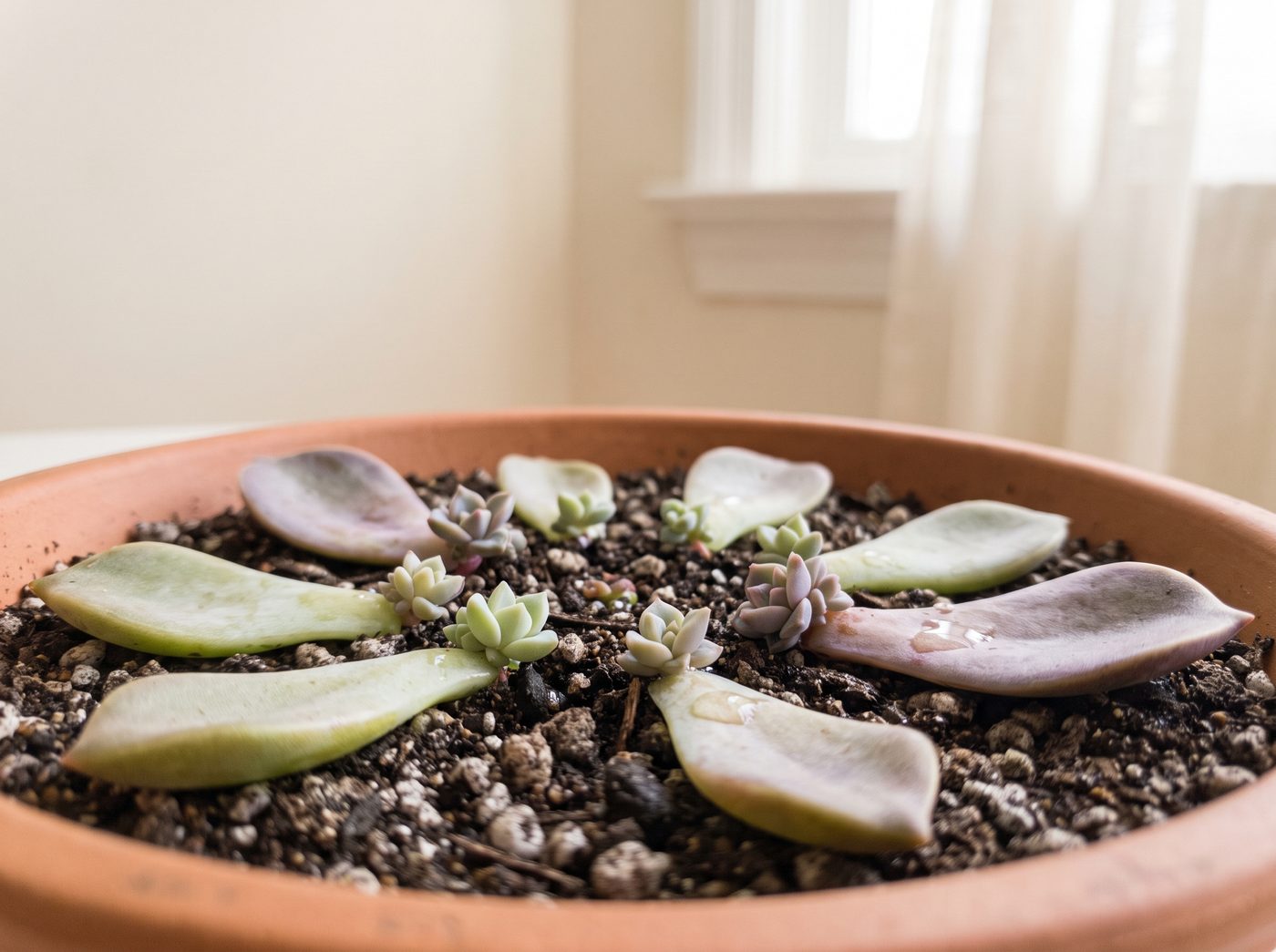
All you have to do is twist off a healthy-looking leaf from the plant, making sure that they break off the stem completely. Let them dry for a few days and then place them in soil. Moisten the soil with a spray bottle every few days. Soon you will see roots beginning to form, and then afterwards, tiny rosettes!
Just know this works best on succulents that have a distinct stem and leaves (like echeveria and graptopetalum). Aloe almost never roots from a leaf, and while a few haworthia species can technically be leaf-propagated, it's slow and unreliable — offsets or division are the better bet for both.
How to Propagate Succulents:
1. Obtain a cutting or leaves
Leaves
When removing leaves, take care to twist gently, and ensure that the entire leaf comes off and there is no part left on the stem. I have had the most success with my propagations whose entire leaf was pulled off. Basically, grab the leaf at its base and wiggle it around gently. Succulent leaves should come off quite easily.
If the leaf breaks part way, with some remaining on the stem, it will be much harder for a new propagation to grow. I have had one prop grow from a broken leaf before so it is not impossible!
When choosing leaves to propagate, pick healthy, plump looking leaves that are a good size. Wrinkled, dried or small leaves will be difficult to grow propagations from.
Cuttings
If your plant has become etiolated, you will want to cut the rosette off and remove all of the remaining leaves on the stem (yay! more leaves to propagate). Leave about 1.5 inches of a stem below the rosette so that you have a long enough area to plant. You can remove some of the leaves on the bottom of the stem so that you have a clean stem to plant.
2. Let the leaf or cutting dry off
Once you have obtained the leaves or cuttings you need, let them dry out and callous over — in my experience this usually takes 2 to 3 days for thinner leaves, though thicker cuttings and some species can take closer to a week. Do not get the open area wet in the meantime - this is an “open wound” and you want to give your plants time to heal. You'll know it's ready once the cut end has visibly shriveled and calloused, which is your cue to plant — not a fixed day count.
If you plant the leaf/cutting before it has had time to properly dry out, it will absorb too much water and have trouble growing.
3. Planting succulent propagations
I have had the best success with simply laying the leaves on top of a pot of soil. I have also tried putting in the cut end of the leaves in the soil but have not had any plants grow that way. As your leaves begin to grow roots, keep the roots covered in soil so that they do not dry out. A mixture of succulent soil and perlite works great.
Unlike leaves, cuttings need to be planted in the soil, just as you would with a full-grown succulent. Put your cutting about an inch deep in the soil and pat soil around to keep it secure.
As tempting as it is, do not move your leaves or cuttings to check for roots. I have definitely been guilty of doing this, and I know how enticing it can be to look for growth, but propagations do best when they are just left alone.
I like to give my cuttings and leaves a bit less sun than my fully-grown plants so they do not dry out.
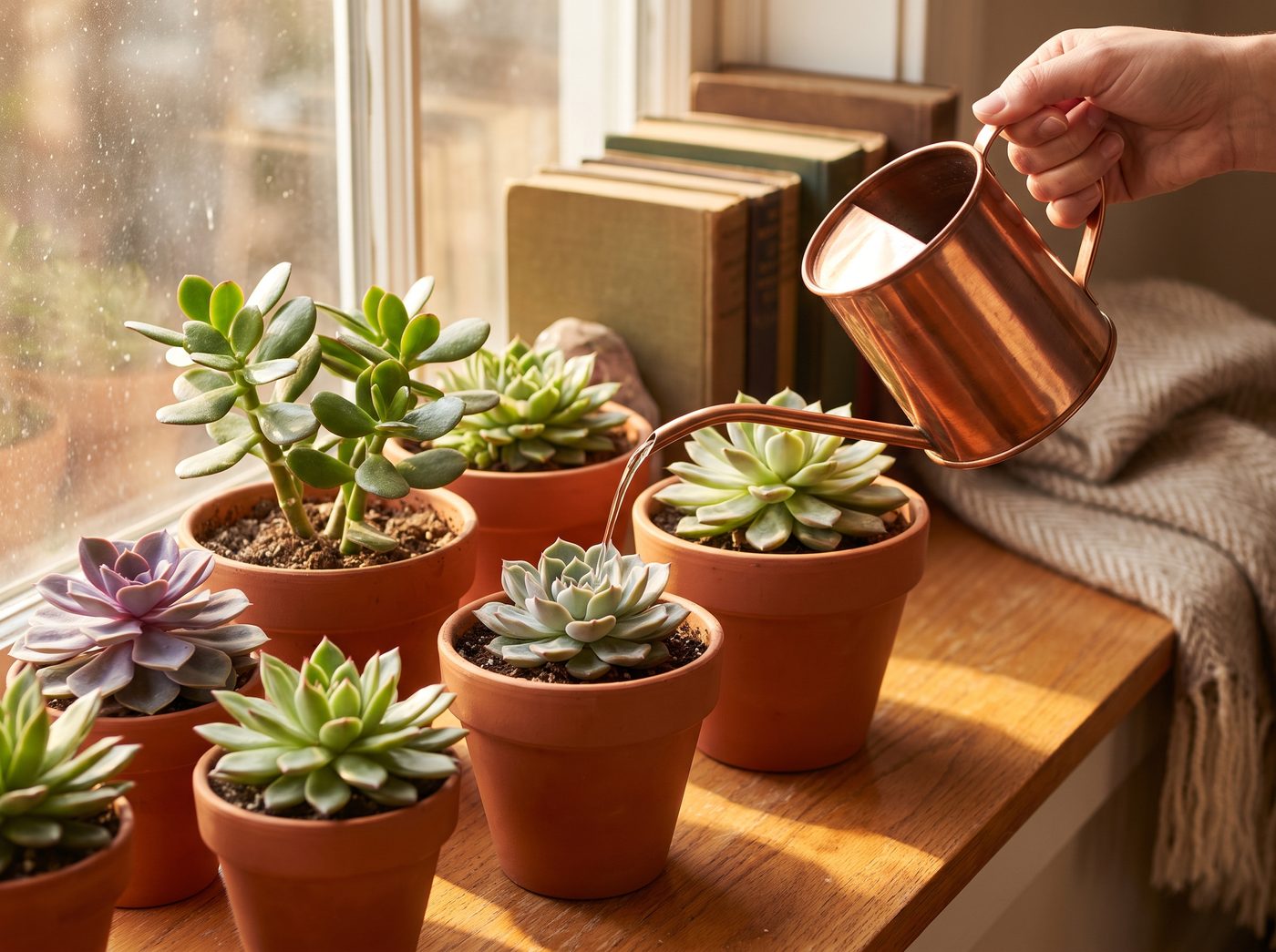
4. Watering your succulent propagations
While fully grown succulents do not need to be watered often, leaves and cuttings do.
Rather than watering right after potting, give your new cuttings a few days to a week to settle into their new soil before the first watering. This helps them stabilize and avoids overwatering an open cut.
For leaves, I have had good results with misting the soil with a spray bottle when the soil turns dry. This is the only time I use a spray bottle when watering succulents!
Like leaves, cuttings should be watered whenever the soil is dry rather than on a fixed schedule — depending on your pot, soil mix and climate that might mean every few days or every couple of weeks.
However, do not water leaves or cuttings too often to prevent them from rotting.
5. Wait for your plant propagations to grow
I have found that the time it takes for roots and new plants to grow varies tremendously by species for each prop I plant. I have had some plants where every prop I plant turns into a new plant, and others where more than half of the leaves die before sprouting any roots. Environmental factors, like temperature, humidity, and season also play a big role in growth.
In general, I usually see roots within 1 to 2 weeks, and small rosettes begin to form a few weeks after that. From there, it will take several months for this new rosette to grow to a larger size.
6. Move propagations to a different pot once large enough
As the new rosette grows, the parent leaf will begin to wither away as it provides nutrients for the new baby. Do not take it off- it will drop off automatically when it is ready.
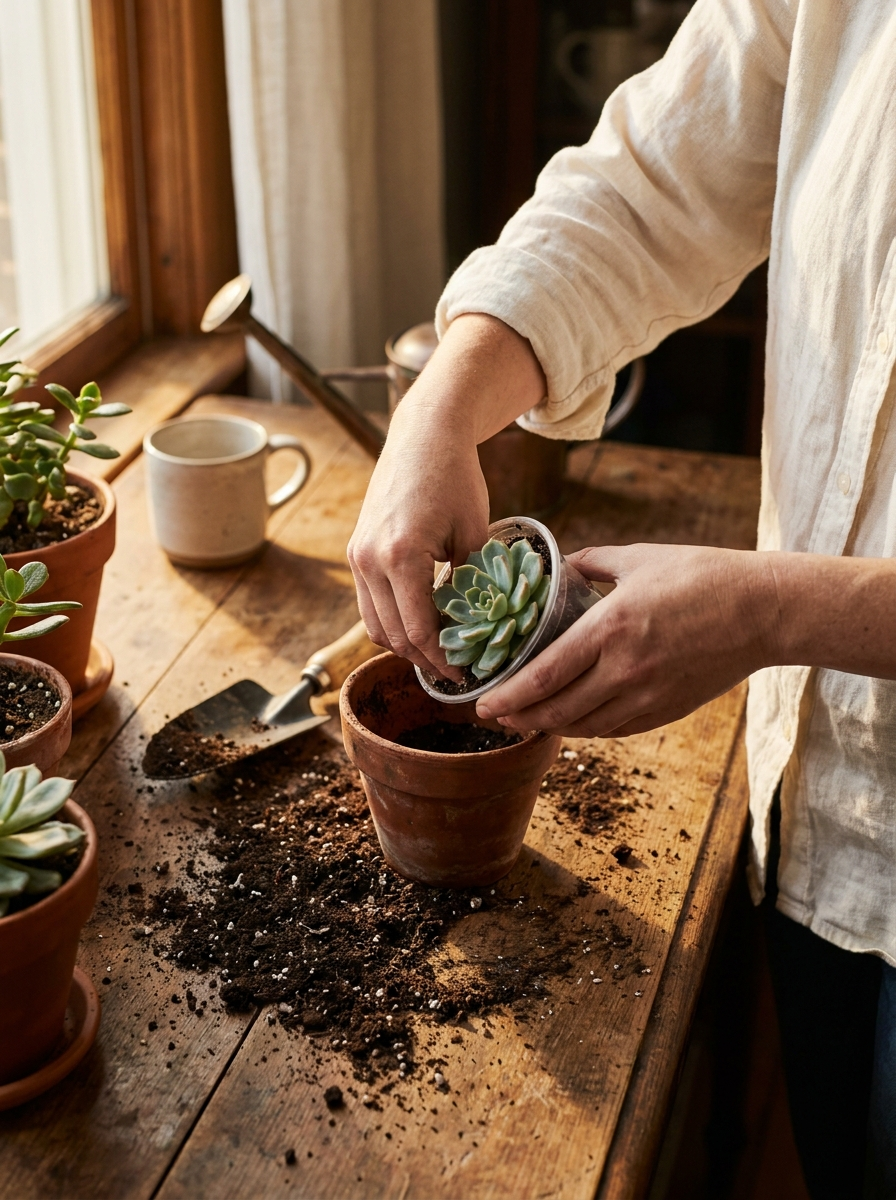
Once the rosette is about 2 cm long, I move it to a different pot. Now it is ready for more light and less water, and you can begin to follow the tips for growing adult succulents.
How to propagate succulents: Are your props not growing?
The most important thing to remember when learning how to propagate succulents is PATIENCE. I have had some props that take FOREVER to grow.
It is completely normal to have leaves from the same plant have completely different results when propagating. It is also normal for several leaves to completely dry out without forming any new roots or rosettes (as sad as this is).
I have had leaves that grow tremendous roots, but never any rosettes, which is a big disappointment. This is all normal, and just makes the props that do grow into rosettes even more exciting!
Propagating from offsets
So I said before that plants like aloe, sempervivum, and haworthia are usually propagated from offsets rather than leaves — leaf propagation is slow and unreliable for them, even where it's technically possible. Offsets (also called pups) are the far more dependable method for these plants. Offsets are basically tiny baby plants that emerge from the base of the main plant.
In fact, sempervivum is so well known for its ability to produce offsets that its nickname is “hen and chicks”, with the “hen” referring to the mother plant and the “chicks” referring to all her offsets!
Soooo basically, you do not have to do anything to get new plants! Your plant does all the work.
For offsets, follow the following steps:
- Wait until they’re big enough to remove. Usually, this means until they are 1 to 2 inches in diameter, or several inches in length.
- Unpot the parent and the pup and uncover the soil from their roots. Find where the two are connected.
- Using a clean pair of garden shears, cut the roots separating them, giving a generous portion of the roots to the baby, since the mother will have an easier time growing new roots.
- Now you can replant the new pup! You can plant the pup into a new pot right away (no need to wait a few days for it to callous this time). Water about 5 days after potting to allow it to settle in its new home. Provide the pup with bright, indirect light and water a bit more frequently than you would the mother.
Propagating succulents from seed
This method is definitely for those people with plenty of patience, because it is the slowest way to grow new succulents. You can collect seeds from a mature plant after it has flowered or buy them. Succulent seeds are very small and can look like dust or dirt.
Keep in mind that growing from seeds is much more difficult than the above methods, and requires a lot of care.
How to grow succulents from seed:
- Fill your planter with well-draining succulent soil mix. Water it thoroughly.
- Soak your seeds in warm water for half an hour to soften them up.
- Spread the softened seeds out on the soil. Leave enough space in between them so that each seed has enough space to grow.
- Cover the seeds with a light dressing of soil, without burying them.
- Water the seeds with a spray bottle (spray bottles are best to avoid overwatering and drowning the seed). Keep them in an area that receives bright, indirect light rather than direct sun, since direct sun through a ziploc bag or humidity dome can quickly overheat and scorch the seedlings.
- Provide the planter with a warm environment (around 75 ºF or 24 ºC) is ideal. If you live in a cooler climate, cover your pot with a ziploc bag poked with some holes to create a greenhouse effect. This will allow you to keep your seeds nice and warm, even when the actual temperature is a bit cooler.
- Each succulent takes a different amount of time to germinate (from weeks to months). You will want to look up the time for your specific species.
- Once you do see sprouts, continue to keep the soil wet. Remove the ziploc lid if you had one.
- Once the plants have an established root system you can slowly reduce your watering frequency.
- Once your succulent is a couple of inches wide, it will be ready to be moved into a new pot. Look up the transplantation size for your succulent species because they can vary. Gently lift the plants from their original pot, set into the soil of the new container, firmly pat the soil around the roots and water well.
And there you have it, new succulents from seeds!
Can you propagate succulents in water?
It's possible, but it isn't the most reliable route for most succulents. Iowa State University Extension notes that most succulents don't root especially well in a glass of water, and generally recommends a well-draining soil or perlite mix instead — which matches what I've found with my own propagations. If you want to try water propagation anyway, let the cutting callus over first just as you would for soil, submerge only the base (keep leaves dry and above the waterline), use untreated water if you can, and change it every few days so it doesn't grow bacteria.
Why isn't my succulent propagation growing? Troubleshooting
- No roots after several weeks: check that the leaf came off the stem completely and cleanly — a partial leaf is much less likely to root. Small or wrinkled leaves also tend to fail more often.
- Leaf or cutting turned mushy or black: almost always overwatering or watering before it had time to callus. Let it dry out and hold off watering until the soil is fully dry again.
- Shriveling up: some shriveling is completely normal as the leaf feeds a new rosette — don't panic unless it's shriveling without any sign of roots or new growth after a month or more.
- Roots but no rosette: disappointing, but it happens even with healthy technique. Not every leaf that roots will go on to form a new plant.
- Nothing happening at all: resist the urge to dig it up and check — disturbing a leaf or cutting is one of the most common reasons propagations fail to root. Leave it alone and give it more time.
How long does succulent propagation take?
Roots typically show up within 2 to 3 weeks, though some leaves can take 6 to 8 weeks with no visible activity before rooting, so a slow start isn't necessarily a failure. A tiny new rosette usually follows a few weeks after rooting, and growing that rosette to a mature size takes several months — propagation rewards patience more than any particular technique.
Does propagating a leaf or cutting harm the parent plant?
Usually not — taking a few leaves or a cutting doesn't harm a healthy succulent in most cases. Cuttings taken to fix an etiolated (stretched-out) plant can actually help it look fuller again, since the remaining stem often sprouts new growth too. Stripping many leaves at once from a small or stressed plant is the one case where it's worth going easier.
Other succulent propagation FAQ
Do I need rooting hormone to propagate succulents?
There are a lot of different opinions on this, but honestly I not noticed an increase in the number of plants that grow when it is used. If you are curious, you can try it, but it definitely is not a quick fix!
Can you propagate in any season?
If you are keeping your propagations indoors, you can have success in any season. If you are keeping them outdoors, propagate in the springtime.
So that is how to propagate succulents! These are the techniques I use to get the best growth. Try them out to propagate your plants like a pro!
Learn more about succulents with the following guides:
Sources
- Iowa State University Extension and Outreach, Yard and Garden — How to Propagate Succulents
- West Virginia University Extension — Succulents 101
- NC State Extension, Plant Toolbox — Haworthia (propagation methods)
This guide combines hands-on experience with the extension sources above; last reviewed August 2026.
Every guide here comes from things I've actually tried on my own plants. Got a plant doing something weird? Send me a photo — I answer every one.
Ask a plant question →