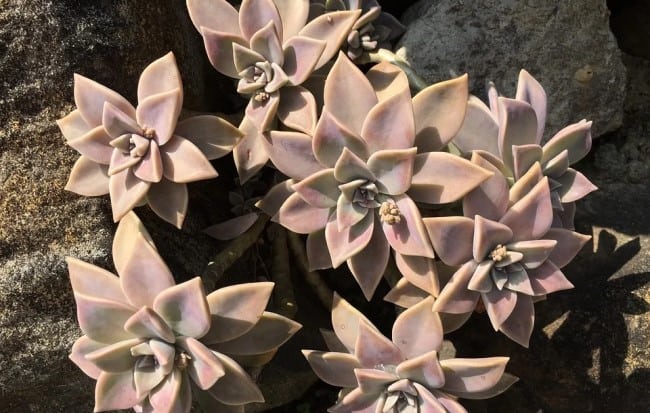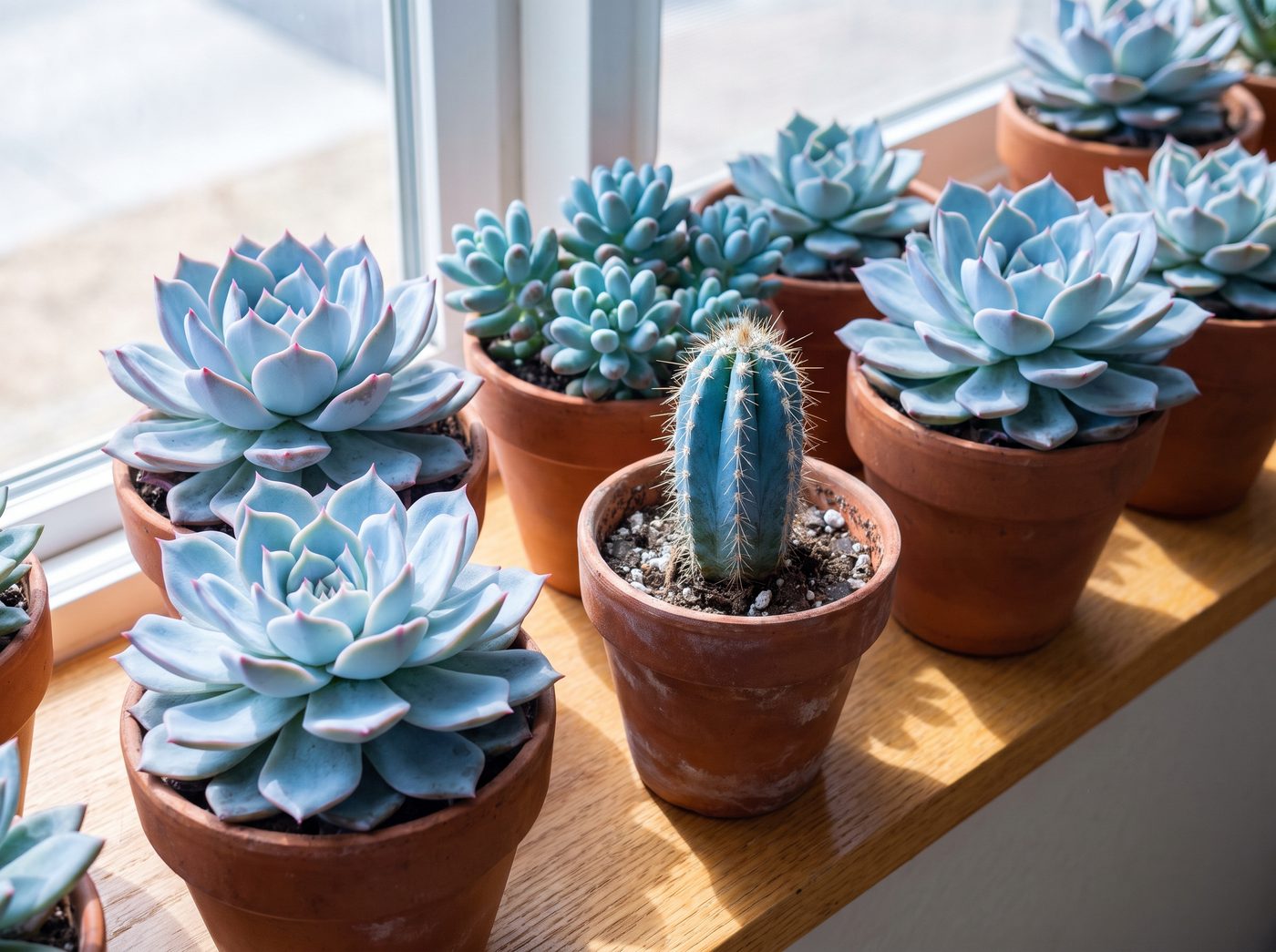
Green plants are great, but sometimes you need to add an extra pop of color. These are 10 gorgeous blue succulents you can add to your garden or centerpieces today to give it a unique look.
A quick note before the list: many "blue" succulents aren't blue-pigmented at all. Their silvery-blue look usually comes from farina — a fine, powdery, waxy coating on the leaf surface — or from natural pigmentation that's strongest in bright light. Both fade in lower light, and farina rubs off easily with handling, so hold these by the pot or a lower leaf rather than gripping the colorful foliage.
1. Pachyveria ‘Powder Puff’
Pachyveria are an Echeveria and Pachyphytum hybrid. They have pointed, chubby leaves that are silvery blue in color. Their tips turn light pink with enough sunlight. Provide your Pachyveria with several hours of full sun every day to bring out its beautiful colors.
Pachyveria are not cold hardy — plan on bringing them indoors before temperatures drop much below 30 °F (-1 °C), and avoid prolonged exposure below 45 °F (7 °C) even if a brief dip to around 20 °F (-6 °C) won't necessarily kill the plant outright. They have the same watering needs as other succulents. In particular, pay attention to the lower leaves of your Pachyveria because they will wrinkle up when it needs a drink. Avoid getting water in the center rosette when watering because it could lead to rot.
This Pachyveria succulent can grow up to 6 inches tall and 7 inches wide. It flowers during the summer season, producing small, bell-shaped apricot flowers. They are easily propagated from cuttings or leaves.
2. Agave parryi var. truncata ‘Artichoke Agave’
Agave parryi, also known as ‘artichoke agave’ has beautiful, thick, silvery blue leaves in a rosette shape. It has dark brown teeth on the edges of its leaves, giving it a unique look.
Agave parryi is a slow-growing plant, reaching up to 2 feet tall and 3 feet wide. Each rosette flowers only once — usually somewhere between 10 and 30 years of age — then dies, though offsets around the base keep the rest of the plant going. When it does bloom, expect a flower stalk reaching up to 20 feet, lined with clusters of creamy yellow flowers.
Native to Mexico, ‘Artichoke Agave’ enjoy full sun, sandy and porous soil, and infrequent watering. It is able to tolerate temperatures as low as 15 °F (-10 °C). It propagates by producing offsets at the base.
3. Echeveria ‘Blue Ruffles’
This Echeveria has wavy blue-green leaves and grows pink flowers when it blooms. It can grow up to 6 inches in height and diameter with proper care.
Like other echeverias, ‘Blue Ruffles’ will require several hours of bright sunlight per day to maintain its color and compact rosette shape. Plant this blue succulent in a well-draining potting soil and allow the soil to fully dry before the next watering. They are not cold tolerant, and are easily damaged by frost.
Many echeverias can be propagated from cuttings, leaves, or offsets, though ease varies by cultivar. Offsets form at the base of the stem, giving Echeveria the nickname of ‘Mexican hen and chicks’ with the main parent plant being the ‘hen’ and the offsets at the base the ‘chicks’.
4. Curio talinoides var. mandraliscae (formerly Senecio mandraliscae) ‘Blue Chalk Sticks’
Native to South Africa, Senecio mandraliscae has long silvery-blue leaves, earning it the nickname ‘blue chalk sticks’ or ‘blue fingers’. It can grow up to 1.5 feet tall and 2 feet wide, and is great to use as ground cover.
It is drought-tolerant and requires infrequent watering. It is able to tolerate full sun to light shade. Like other succulents, blue chalk sticks will thrive in a well-draining potting soil. They are not frost-tolerant, so if you plan on keeping them outside, bring them in on a cold day.
‘Blue chalk sticks’ is easily propagated from cuttings. During the summer season, it can grow white flowers.
5. Echeveria ‘Blue Prince’
The Echeveria ‘Blue Prince’ needs full sunlight to really bring out its blue and purple tones and maintain its compact rosette shape. Provide this blue succulent with at least 6 hours of bright sunlight, ideally in a south-facing window or under a grow light, every day for it to thrive. Insufficient light can lead to the stem stretching out (etiolation).
During the spring season, ‘Blue Prince’ can produce yellow and orange flowers. It grows up to 6 inches wide with proper care.
Like other succulents, plant ‘Blue Prince’ in well-draining soil and do not let it stay wet for too long. Water only when the soil is completely dry, and keep it in a room with good airflow. Echeveria are not cold-hardy and cannot handle temperature extremes.
6. Echeveria ‘Blue Bird’
Yes, it is another Echeveria (can you tell they are my favorite?). The ‘Blue Bird’ has light blue silvery leaves whose tips turn pink in full sun. On its leaves is a powder called farina. Farina is a white, waxy coating that protects the leaves and gives it a pastel hue. Farina can easily be damaged by excessive touching of the leaves, so be careful when repotting your ‘Blue Bird’.
Like the other Echeverias, provide your ‘Blue Bird’ with several hours of bright sun per day, plant in a well-draining potting soil, do not expose to frosty conditions, and water only when the soil is dry.
With proper care, Echeveria ‘Blue Bird’ can grow up to 9 inches in diameter and 5 inches in height. Their blooms are pink in color, and they are propagated through offsets, cuttings and leaves.
7. Pilosocereus pachycladus (syn. Pilosocereus azureus) ‘Blue Torch Cactus’
Pilosocereus azureus, also known as ‘Blue Torch Cactus’, is a tall, columnar cactus native to Brazil. Bright light helps this cactus keep its characteristic blue color, though a plant grown in lower light won't necessarily turn bluer just by adding more sun suddenly — acclimate it gradually to avoid scorching. With yellow spines that pop out against the blue plant, this cactus will stand out in any garden or arrangement.
The blue torch cactus can grow up to 30 feet tall and is a very low-maintenance plant, making it great for busy people. Just provide full sun, well-draining soil, and water thoroughly during active growth and let the mix dry out between waterings — it's quite drought-tolerant once established. Keep an eye out for pests, such as mealybugs.
‘Blue Torch Cactus’ can be propagated by cuttings– just cut off the top, let it callous, and replant it into a new pot.
8. Sedeveria ‘Blue Elf’
A Sedum and Echeveria hybrid, Sedeveria ‘Blue Elf’ has blue-green leaves in a rosette shape, with a coating of farina. With enough sun, the tips can turn a lovely pink color.
Sedeveria can produce bright yellow blooms several times a year, earning it the nickname ‘Happy Plant’. Provide your Sedeveria ‘Blue Elf’ with the same conditions as other succulents: well-draining soil, sunlight, and infrequent waterings, and maybe you will be rewarded with blooms too.
Sedeveria remain small, with a maximum height and width of 4 inches. It is not cold-hardy, so keep out of frosty conditions.
9. Graptopetalum pachyphyllum ‘Blue Beans’
Graptopetalum pachyphyllum is a branched, sprawling succulent with densely packed leaves and stems that can grow to 9 inches long. Its chubby blue-green leaves look like jelly beans, giving it its nickname ‘Blue Beans’.
With the same care needs as other succulents, provide Graptopetalum pachyphyllum with bright light — full sun is fine in mild climates, but some afternoon shade helps in hotter ones — water when the soil is dry, and plant in a well-draining potting soil. Do not keep it at a temperature lower than 25°F (-4 °C). Its fleshy leaves and need for excellent drainage make ‘Blue Beans’ relatively drought-tolerant once established, even though it naturally grows on shaded, rocky cliffs rather than open desert.
Graptopetalum pachyphyllum can easily be propagated by leaves or cuttings. If you have a friend who has one, ask them for a cutting!
10. Pachyphytum oviferum ‘Moonstones’
Pachyphytum oviferum’s plump round leaves have earned it the nickname of ‘sugaralmond plant’ or ‘moonstones’. In fact, the name Pachyphytum oviferum means ‘thick plant bearing eggs’. The chubby leaves are coated with farina for sun protection, which helps give this blue succulent a pastel look. Handle the leaves with care, because the coating can easily be removed.
The leaves on Pachyphytum oviferum range from pale blue to bluish-purple. It does best with bright light. If your Pachyphytum is indoors, rotate the pot every few days so that each side of the plant gets enough sunlight. When watering, make sure you water the soil at the base of the plant- if water gets on the leaves or in the rosette, it could lead to rot.
Pachyphytum can grow up to 8 inches tall and 4 inches wide.
Blue Succulent FAQ: Why are my blue succulents turning green?
If your succulent has turned green after a few weeks, there is nothing wrong with it- green succulents are still healthy and nothing needs to be done.
If you really want your succulent to go back to the vibrant blue colors it had, try easing it into an area with more sun (but not too quickly or it can sunburn!). South-facing windows are best because they provide plenty of light. If you find your windows are not providing enough sun, you may have to get a grow light and put your succulent under it.
These are 10 beautiful blue succulents to brighten up your garden and make it pop. Which ones are you going to add to your garden? Which one is your favorite?
Want to add even more color to your garden? Check out the top 10 pink succulents to keep in your garden:
Want to learn more about general succulent care? Check out this article:
Blue succulent care: frequently asked questions
How do I get my succulent's blue color back?
Ease it into a brighter spot over a week or two rather than moving it into full sun right away, since a sudden jump in light can scorch leaves that have adjusted to lower light. A south-facing window is usually the brightest option indoors; a grow light works well if your windows don't provide enough sun.
Are blue succulents harder to care for than green ones?
Not really — the blue coloring is mostly about light exposure, not a different care routine. Most of the succulents on this list want full sun, well-draining soil, and infrequent watering, the same baseline as other desert succulents. The main extra thing to watch for is avoiding water and excess handling on leaves coated in farina, since that powdery coating rubs off easily and often doesn't return on that same spot.
Sources
- World of Succulents — species profiles for Pachyveria 'Powder Puff', Agave parryi var. truncata, Graptopetalum pachyphyllum, and Pachyphytum oviferum
- Missouri Botanical Garden, Plant Finder — Agave parryi
- Kew Science, Plants of the World Online — accepted names for Curio talinoides var. mandraliscae and Pilosocereus pachycladus
This guide combines hands-on experience with the grower/reference sources above; last reviewed August 2026.
Every guide here comes from things I've actually tried on my own plants. Got a plant doing something weird? Send me a photo — I answer every one.
Ask a plant question →